Emergency Training in English for Medical Teams in Germany

On-site CPR and emergency training – by an experienced paramedic

Request your training

Flat fee · Reply within 24 hours · Anywhere in Germany

700+
training sessions delivered
17 years
in emergency medical services – paramedic
QM-compliant
meets the G-BA guideline & QPR
5.0 ★
from 26 Google reviews

Fully in English – from check-in to certificate

Whether your practice works in English, many of your patients are international or your care team brings together nurses from many countries: in an emergency, every second counts. Nobody should lose time translating instructions in their head. That is why we deliver our emergency training entirely in English on request.

Everything your team sees and hears is in English: the digital check-in, the hands-on case scenarios, the feedback form and the personal certificate. For mixed teams we also run the training bilingually in German and English, so that everyone can follow and the whole team trains the same procedures together.

Digital check-in

Training & case scenarios

Feedback form

Certificate with QR code

Who the training is for

Designed exclusively for medical and nursing professionals

Medical & dental practices

GP, paediatric, dental and orthodontic practices, psychotherapy and occupational medicine – with English-speaking teams or international patients.

Care homes & home care

Care teams with international nursing staff – fully in English or bilingual, so that everyone acts confidently in an emergency.

Nursing & medical assistant schools

Emergency and CPR training for international students and internationally trained nurses – as a module within your course.

We do not run workplace first-aid courses for companies.

What your team will train

On site at your premises

With your team, in familiar surroundings and with your own emergency equipment.

Manikins with feedback

Sensor technology shows compression depth, chest recoil and ventilation in real time.

Certificates

Personal certificates in English with a tamper-proof QR code – your proof for audits.

Flexible duration

2, 3 or 4 hours – tailored to your needs.

Adult emergencies

  • CPR with AED
  • Unconsciousness / syncope
  • Emergency call (112)
  • Stroke
  • Heart attack (ACS)
  • Acute shortness of breath
  • Allergic reaction (anaphylaxis)
  • Seizures
  • Choking
  • Poisoning (e.g. medication overdose)
  • further emergencies on request

Paediatric emergencies

  • Infant CPR
  • Child CPR
  • Unconsciousness
  • Choking
  • Breathing difficulties
  • Croup
  • Febrile seizure
  • Fractures
  • Allergic reaction (anaphylaxis)
  • Poisoning
  • further emergencies on request

Every training is tailored to your team: we focus on the emergencies that actually occur in your practice or facility. We will gladly check your emergency kit too – free of charge.

Meets German quality management requirements

If you run a practice or care facility in Germany, emergency training is not optional. The quality management guideline of the Federal Joint Committee (G-BA QM-RL) requires medical, dental and psychotherapy practices to have working emergency management: the whole team must master life-saving measures and refresh them regularly. Care facilities are assessed under the quality inspection guidelines (QPR).

Our training is designed to meet these requirements. Every participant receives a personal certificate with a tamper-proof QR code, and you receive a complete list of participants for your QM documentation – ready for your next audit.

We train teams on site anywhere in Germany – we come to your practice, facility or school.

Your trainer

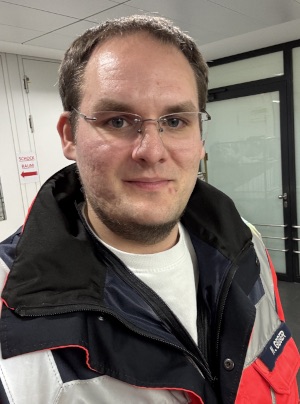
Michael Geiger, paramedic and emergency trainer

Michael Geiger – experience from the field, for your team

I am a Notfallsanitäter – a paramedic with the highest non-physician qualification in German emergency medical services – and have been working on ambulances for 17 years. My career has taken me through every level of the German ambulance service, from first-aid helper to paramedic, so I can relate to very different levels of knowledge and perspectives.

For more than six years I have been running hands-on emergency training – over 700 sessions for medical practices, care facilities and medical teams. My aim is training that is clear, relevant and engaging: no dry lectures, but realistic case scenarios that give your team confidence and routine for the real thing.

Training languages: English and German – or both at once. I speak fluent English (C1).

Reviews

What participants say about the training

"Very good, hands-on emergency training for our practice team. The content was explained clearly and taught through lots of practical exercises, so everyone could take an active part. The trainer has a pleasant, calm manner and responds very well to questions. We now feel much more confident about handling possible emergencies in the practice. Highly recommended."

Kleinsman Varzideh Dental Center (Bocholt)

Translated from German

"The emergency training with Michael was very interesting, well structured and full of practical case studies. He tailored everything perfectly to our general practice! Thank you, Michael"

Susanne (Google review)

Translated from German

"The first aid course was truly excellent. The instructor, an experienced paramedic, impressed us with his enormous expertise and answered every question thoroughly and clearly. […] We now feel much more confident and well prepared for future emergencies. We would love to have this instructor again."

Eva (Google review)

Translated from German

Frequently asked questions

Yes. On request, we deliver the whole training in English: all hands-on case scenarios – and also the digital check-in, the feedback form and the participants’ certificates.

Yes – bilingual training is often the best choice for mixed teams, for example in care facilities with international nursing staff. We explain the key points in both German and English, so that everyone can follow and the whole team practises the same procedures together. On request, we also practise the emergency call to 112, including the most important German phrases.

Yes. Every participant receives a personal certificate in English documenting the date, duration and content of the training.

Each certificate carries a tamper-proof QR code: an encrypted digital signature lets anyone verify its authenticity instantly. You also receive a complete list of participants for your QM documentation and audits.

Yes. The quality management guideline of the Federal Joint Committee (G-BA QM-RL) requires medical, dental and psychotherapy practices to have working emergency management – which means the whole team must master life-saving measures and refresh them regularly. Care facilities are assessed under the quality inspection guidelines (QPR). Our training is designed to meet these requirements, and the certificates document it for your audits.

On site, in your own premises – anywhere in Germany. Your team practises in familiar surroundings and with its own emergency equipment; we bring all training equipment and consumables with us. All we need is a room where we can practise together.

You choose 2, 3 or 4 hours, depending on your needs. You pay a flat fee, regardless of the number of participants – and there is no minimum group size. To leave enough time for hands-on practice, we recommend groups of up to 15 people; for larger teams we simply plan several sessions. Send us a short request and you will receive your quote within 24 hours.

Yes. We teach CPR and emergency care at vocational schools and training providers – in nursing, nursing assistant and medical assistant (MFA) training as well as in courses for internationally trained nurses. We deliver the emergency training as a module within your course; the course itself, its curriculum and its recognition remain the responsibility of your school. We bring resuscitation simulators with electronic feedback and an airway trainer for supraglottic airway devices and intubation, and align content and scope with your curriculum.

Of course. We train with adult, child and infant manikins, all equipped with sensor technology: during practice, participants get instant, objective feedback on compression depth, chest recoil and ventilation – so everyone can perfect their technique during the training.

With most state medical associations (Landesärztekammern) this is possible – deadlines and requirements depend on the association concerned. We are happy to check this for you in advance. Please mention it in your request, as CME points usually cannot be applied for retrospectively.

No. A first-aid course trains lay people as workplace first aiders: nine teaching units with standardised content at a body authorised by the German statutory accident insurance (Berufsgenossenschaft). Our emergency training is aimed at medical and nursing professionals and goes considerably further: we train in your premises, with your own emergency equipment, on the typical emergencies in your profession and with the procedures of your team – and thereby meet the requirements of the G-BA QM guideline and the QPR. We do not offer first-aid courses for companies.

How it works

1
Send your request

Takes 2 minutes using the form – free and with no obligation.

2
Receive your quote

Within 24 hours – a flat fee, regardless of the number of participants.

3
Training on site

Your team trains in familiar surroundings – certificates included.

Request a free, no-obligation quote

* Required fields Your data will only be used to prepare your quote (Privacy policy).
Request a quote – reply in < 24 h